Positive Dog Training & Behaviour Blog | Walkabout Canine Consulting
Unleashing your dogs potential, one concept at a time
Why Resource Guarding Is Not Dominance
 Sylvia Koczerzuk
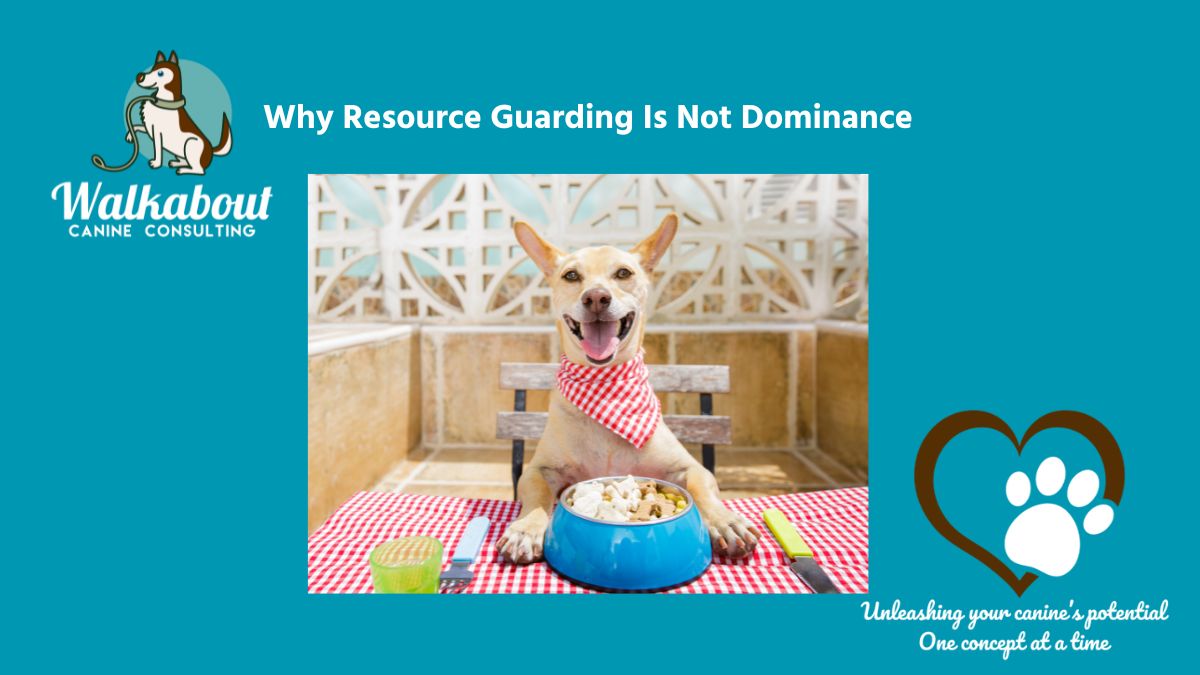
Resource guarding is not dominance. Learn why dogs guard food, toys, spaces, and people, and how compassionate behaviour support can help.
Resource guarding is one of the most misunderstood dog behaviour problems.
A dog growls over a bone, stiffens near a food bowl, snaps when someone reaches for a toy, freezes on the couch, or becomes tense when another dog approaches. Very quickly, people may be told, “Your dog is dominant,” “You need to be the alpha,” or “Do not let your dog win.”
This advice is not only outdated, it can be dangerous.
Resource guarding is not about a dog trying to take over the household. It is usually about worry, insecurity, conflict, previous learning, or fear of losing something valuable.
When we misunderstand guarding as dominance, we often respond with confrontation. When we understand guarding as communication, we can create safety and change the dog’s emotional response.
What is resource guarding?
Resource guarding happens when a dog uses behaviour to keep control of something they value.
The guarded resource may be:
- Food
- Bowls
- Bones
- Chews
- Toys
- Stolen items
- Beds
- Couches
- Doorways
- Crates
- People
- Space
- Access to another dog
- Resting areas
- Outdoor finds
Guarding can look subtle or intense. Early signs may include freezing, hovering, hard staring, eating faster, turning the body away, lowering the head, whale eye, lip licking, or moving away with the item. More obvious signs may include growling, snarling, snapping, lunging, or biting.
The growl is not the problem by itself. The growl is information. It is the dog saying, “I am uncomfortable. I am worried. Please give me space.”
If we punish the growl, we may remove the warning without changing the worry underneath.
Why dominance is the wrong explanation
Dominance-based explanations suggest the dog is trying to gain status or control over the human. This often leads people to take items away, stand over the dog, put hands in the bowl, physically move the dog, scold, intimidate, or challenge the dog.
But most guarding does not improve when the dog feels more threatened.
If a dog is worried about losing a valuable item and a person repeatedly takes the item away, the dog learns that people approaching really do mean loss. The guarding may become more intense. The dog may eat faster, hide items, stiffen sooner, growl more quickly, or bite without as much warning.
From the dog’s point of view, confrontation confirms the concern.
The question should not be, “How do I show my dog I am in charge?”
The better question is, “How do I help my dog feel safe enough not to guard?”
Resource guarding is about emotion and expectation
Dogs guard because they expect that something valuable may be taken, threatened, or competed for.
Some dogs guard because they have had items removed repeatedly. Some guard because other dogs in the home hover or steal. Some guard because they are hungry, stressed, tired, anxious, in pain, or living in a busy environment. Some have genetic or early-life tendencies toward possession. Some guard only specific high-value items. Some guard only from other dogs. Some guard only from children or unfamiliar people.
The behaviour makes more sense when we look at the whole picture.
A dog who growls over a chew is not making a moral choice. The dog is responding to a perceived threat around something valuable.
Why taking things away can make guarding worse
Many people are told to practice taking the food bowl away to prove the dog should tolerate it. Unfortunately, this can teach the opposite lesson.
If every approach predicts loss, the dog has a reason to worry.
A safer approach is to teach the dog that human approach predicts something good, not something threatening. For example, approaching at a safe distance and adding something better can help change the dog’s expectation over time.
The goal is not to trick the dog or bribe the dog. The goal is to build trust and predictability.
When done correctly, the dog learns, “When people come near, good things happen. I do not need to panic. I do not need to defend this.”
What not to do with a resource guarding dog
Avoid advice that increases pressure or conflict.
Do not:
- Put your hands in the dog’s bowl to prove a point
- Take food or chews away repeatedly
- Punish growling
- Chase the dog with stolen items
- Physically pry the mouth open unless it is a true emergency
- Scold the dog for warning
- Allow children to approach eating or resting dogs
- Let other pets crowd the guarding dog
- Use dominance or alpha-based methods
- Force trades without a plan
Safety comes first. Management is not failure. It is responsible.
What to do instead
A compassionate resource guarding plan often includes several parts.
1. Management
Management prevents rehearsal of guarding and reduces risk.
This may include feeding dogs separately, giving chews only in safe spaces, using gates, teaching children not to approach, keeping counters clear, removing trigger items, and setting up the home so conflict is less likely.
Management does not mean the dog is “getting away with it.” It means we are preventing predictable problems while we build skills.
2. Observation
We need to know what the dog guards, from whom, in what locations, and at what intensity.
A dog who guards from another dog needs a different plan than a dog who guards from a toddler. A dog who guards stolen tissues needs a different setup than a dog who guards resting space. A dog who guards only long-lasting chews may not need the same plan as a dog who guards every bowl of food.
Details matter.
3. Teaching safe exchanges
Many guarding plans include teaching a voluntary trade or exchange. This should be done carefully, starting with low-pressure items and high-value rewards.
The dog should learn that giving something up does not always mean permanent loss. Sometimes the dog gets something better. Sometimes the item comes back. Sometimes the human simply moves away.
Trust is built through repetition and predictability.
4. Changing the emotional response
This is the heart of behaviour modification.
We want the dog to feel differently when a person or another animal approaches. Instead of “Oh no, they are going to take this,” the dog begins to learn, “Their approach is safe. Good things happen. I can relax.”
This process must happen at the dog’s pace and below the level where the dog feels the need to guard intensely.
5. Teaching humans what to notice
Resource guarding rarely comes out of nowhere. There are often early signs.
Learning body language is essential. Watch for stillness, hard eyes, head lowering, body blocking, faster eating, turning away, hovering, tension around the mouth, and changes in posture.
When people learn to notice early signs, they can respond before the dog feels pushed into growling, snapping, or biting.
Resource guarding in multi-dog homes
Multi-dog households can make guarding more complicated.
Dogs may guard from each other even if they do not guard from people. One dog may hover, steal, stare, or pressure another dog. A dog may guard resting spaces, doorways, toys, chews, food bowls, or human attention.
In these homes, the plan must look at the whole system. Feeding separately, using gates, creating resting zones, supervising high-value items, and preventing pressure between dogs may be necessary.
The goal is not to force dogs to share everything. Dogs do not need to share every valuable resource to live peacefully. They need safe routines and clear human support.
Resource guarding and children
Children and resource guarding require special care.
Children should not be asked to train a guarding dog. They should not approach a dog who is eating, chewing, resting, hiding, or holding a valued item. Adults must manage the environment.
Even a “good dog” can bite if they feel trapped or threatened around a valuable resource. Safety planning protects both the child and the dog.
Does resource guarding mean my dog is bad?
No.
Resource guarding does not mean your dog is bad, spoiled, dominant, or ungrateful. It means your dog is struggling with the possibility of losing something important.
That does not mean the behaviour should be ignored. Guarding can be serious and may create safety risks. But responding with fear or punishment usually makes the underlying emotion worse.
A calm, structured, compassionate plan is more effective than confrontation.
Can resource guarding improve?
Yes, many resource guarding cases can improve significantly with the right plan.
Progress may look like:
- Less tension when people approach
- Safer feeding routines
- Better trades
- Fewer conflicts between dogs
- Improved trust around valued items
- More predictable household management
- Humans who understand what to do and what not to do
- A dog who no longer feels the same need to defend resources
The goal is not to prove control. The goal is to reduce the dog’s worry and increase safety.
When should you get professional help?
Seek help from a qualified behaviour consultant if:
- Your dog has growled, snapped, or bitten
- Children are in the home
- Multiple dogs are involved
- The guarding is increasing
- The dog guards many items or spaces
- You feel afraid or unsure what to do
- Previous advice has made the behaviour worse
Resource guarding can be complex, and safety matters. A professional plan can help you avoid common mistakes and move forward more confidently.
Final Thoughts
Resource guarding is not dominance. It is communication.
When a dog guards, they are telling us they feel concerned about losing something valuable. If we respond with confrontation, we may confirm the dog’s fear. If we respond with understanding, management, and careful behaviour modification, we can help the dog feel safer.
Your dog does not need to be challenged. Your dog needs clarity, predictability, and compassionate support.
Resource guarding can feel frightening and frustrating, but it is also a behaviour that can often be improved when we stop asking, “How do I win?” and start asking, “How do I help my dog feel safe?”
If your dog guards food, toys, spaces, or people, start with support. Book at Discovery Call HERE
Explore the Resource Guarding EBOOK and more HERE
You can also find my published book on Amazon on Kindle, Paperback and Hard back.
Categories: : aversive dog training, dog behaviour consulting, dominance in dogs, resource guarding in dogs