Positive Dog Training & Behaviour Blog | Walkabout Canine Consulting
Unleashing your dogs potential, one concept at a time
Tired Is Not the Same as Calm: Why Your Dog Can’t Relax
 Sylvia Koczerzuk
Learn why a tired dog may still struggle to relax, and how decompression, recovery routines and calmness skills can help your dog switch off at home.
Tired Is Not the Same as Calm: Why Some Dogs Struggle to Switch Off
Why can’t my dog relax after exercise?
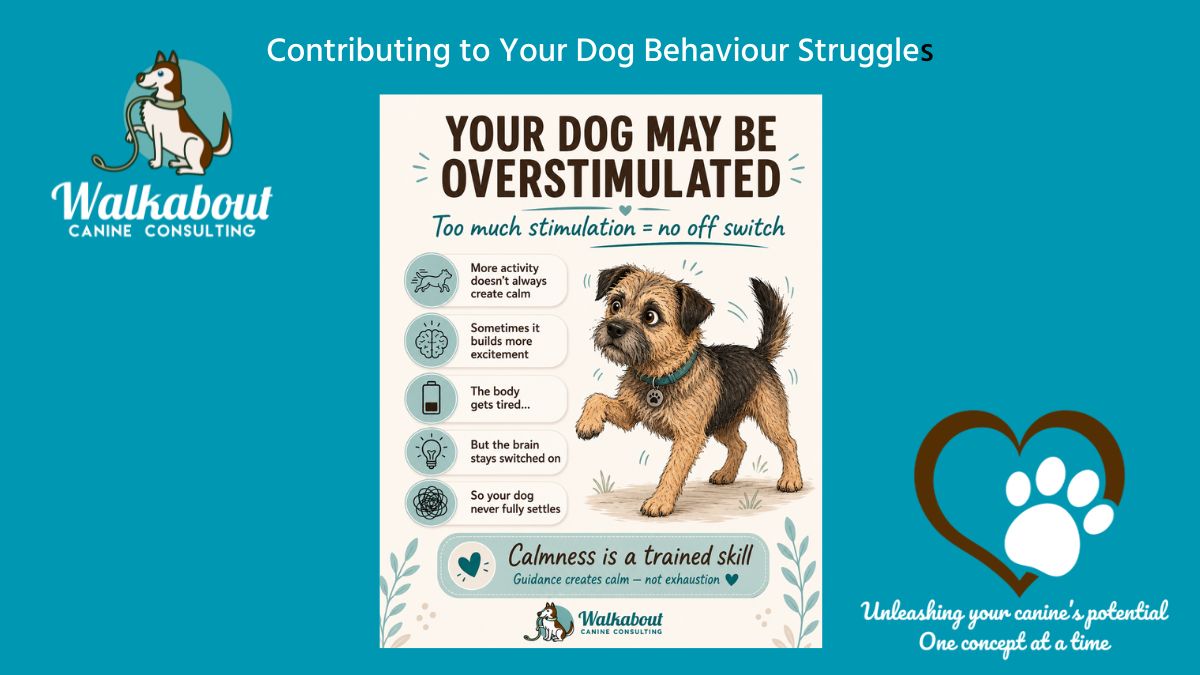
A dog can be physically tired while their brain and nervous system remain highly activated. More exercise may create additional excitement rather than recovery. Structured decompression, predictable rest and opportunities to practise settling can help the dog move from activity into calm.
You have walked your dog. You have played fetch. You have provided enrichment, training and perhaps even a trip to daycare.
Your dog should be tired.
Yet there they are—pacing through the house, panting, following you from room to room, barking at every little sound or grabbing toys and demanding another round of play.
It is tempting to conclude that your dog simply needs more exercise. But sometimes, adding more activity is like trying to settle an overtired toddler by taking them to an amusement park. The body may become exhausted while the brain remains fully switched on.
Tired is not always the same as calm.
For some dogs, the missing piece is not more physical activity. It is learning how to move from activity into recovery.
When More Exercise Creates More Excitement
Physical exercise is an important part of a dog’s wellbeing. Dogs need opportunities to move, explore, play and engage in natural behaviours.
The problem is not exercise itself. The problem occurs when we rely on increasingly intense activity as the primary way to create calmness.
A dog who regularly participates in fast-paced activities may become physically fitter and capable of doing even more. The thirty-minute game of fetch that once seemed tiring may no longer have the same effect. The guardian adds another walk, more ball throwing or another play session, but the dog still appears restless.
This can create a cycle:
- The dog appears unsettled.
- More exciting activity is added.
- The dog becomes increasingly aroused.
- The activity stops, but the dog cannot easily settle.
- The guardian assumes the dog still needs more exercise.
The dog may be physically tired, but their nervous system has not yet shifted into a state that supports rest.
It is a little like pressing the accelerator repeatedly and then wondering why the engine does not immediately become quiet.
What does an overstimulated dog look like?
Dogs do not all express overstimulation or difficulty settling in the same way. You may notice:
- pacing or wandering around the house
- panting when the dog is not hot
- repeatedly bringing toys
- barking for attention
- jumping, mouthing or grabbing clothing
- reacting strongly to small noises or movements
- difficulty lying down for more than a few moments
- following family members constantly
- becoming wild or frantic during the evening
- struggling to sleep during the day
- appearing exhausted but remaining restless
These behaviours are not necessarily deliberate misbehaviour. They may be signs that the dog needs help moving out of excitement and into recovery.
When should restlessness be discussed with a veterinarian?
Always discuss behaviour with your veterinarian as behaviour changes or abnormalities can be a medical issue that only you and your veterinarian can determine.
Persistent restlessness should not automatically be labelled as overstimulation. Pain, gastrointestinal discomfort, itching, medication effects, anxiety, sleep disruption and other health concerns can also affect a dog’s ability to settle. A noticeable or sudden behavioural change deserves a conversation with your veterinarian.
Can too much exercise make a dog more restless?
We spend a great deal of time teaching dogs how to do things.
We teach them to sit, come when called, walk on leash, retrieve toys, participate in sports and respond to cues.
We may spend far less time helping them learn what happens after activity.
Some dogs naturally curl up and sleep once an activity is finished. Others need more guidance, predictability and practice. This is especially common in puppies, adolescent dogs, highly alert dogs and dogs who have experienced chronic stress or inconsistent routines.
Calmness is not created by repeatedly telling a dog to “settle down.” It develops through experiences that help the dog feel safe enough to rest.
Rather than viewing calmness as the absence of behaviour, we can look at it as a collection of skills:
- disengaging from activity
- lowering physical intensity
- tolerating quieter moments
- choosing to lie down
- remaining settled while life continues nearby
- recovering after excitement
- sleeping deeply enough to restore the body and brain
These skills can be supported and practised.
How do I help my dog switch off?
After an exciting walk, play session or visitor, your dog may need a transition period.
Moving directly from intense activity into complete stillness can be difficult. A decompression routine helps bridge that gap.
This might include:
- a slow sniffing walk
- scattering food in the grass
- a simple scent search
- licking a stuffed food toy
- chewing an appropriate item
- gentle exploratory movement
- quiet time in a familiar resting area
Sniffing can be particularly useful because it allows the dog to gather information while moving at a slower pace. The goal is not to wear the dog out by making the activity harder. The goal is to help the dog shift gears.
Think of decompression as the cool-down period following exercise.
Reinforce the Beginning of Calm
Guardians often notice unwanted behaviour immediately but miss the small moments when the dog is beginning to settle.
Your dog pauses.
They take a breath.
They stop following you.
They soften their body.
They place one hip on the floor.
They lower their head.
These moments matter.
Quietly placing a treat between your dog’s paws can reinforce the behaviour without creating a burst of excitement. You can also offer calm verbal feedback, provided your voice does not cause the dog to leap up again.
We are not trying to reward only perfect relaxation. We are noticing and reinforcing the small steps that lead towards it.
Calmness is often built in layers:
Active → slowing down → settling → relaxing → sleeping
Expecting a dog to jump from full-speed activity directly into deep relaxation may be unrealistic.
Create Predictable Rest Opportunities
Dogs need adequate sleep and uninterrupted downtime. Yet in a busy household, some dogs struggle to rest because something is always happening.
Children move through the room. Deliveries arrive. Other pets play. Family members interact with the dog whenever they walk past.
A dog may be tired but continue monitoring the environment.
A predictable resting routine can help. Consider:
- a comfortable bed in a low-traffic area
- baby gates or barriers to reduce interruptions
- curtains or window film for dogs who watch outside
- white noise or quiet background sound
- scheduled periods when the dog is not approached
- separating dogs when they need uninterrupted rest
- providing puppies with regular nap opportunities
Rest should not be used as punishment. The resting area should feel safe, comfortable and familiar.
Choose Activities That Match the Dog in Front of You
Not every calming activity is calming for every dog.
A food toy may settle one dog and frustrate another. A chew may encourage rest in one household but create tension in a multi-dog home. A walk may be decompressing in a quiet area but overwhelming on a busy street.
Watch the effect the activity has on your individual dog.
After the activity, does your dog appear:
- softer in their body?
- able to disengage?
- less watchful?
- more able to lie down?
- ready to sleep?
Or do they appear:
- more frantic?
- more demanding?
- more reactive?
- unable to stop?
- frustrated when the activity ends?
The activity itself does not determine whether it is calming. The dog’s response does.
How much rest does my dog need?
A Simple Calmness Routine
Try this after a walk or play session:
First, lower the intensity. Finish with a few minutes of slower movement or sniffing rather than ending at the most exciting point.
Next, offer a quiet activity. Use a scent search, scatter feed, chew or stuffed food toy that your dog already finds soothing.
Reduce environmental stimulation. Dim the activity in the household and guide your dog towards a comfortable resting area.
Notice early signs of settling. Calmly reinforce pauses, softer body language, lying down and resting the head.
Protect the rest period. Once your dog settles, allow them to remain undisturbed.
With repetition, this sequence becomes familiar:
Activity happens, recovery follows, and rest is safe.
Calmness Does Not Come From Exhaustion
A fulfilled life includes physical exercise, play, social connection, exploration, training, sleep and recovery.
The goal is not to create a dog who remains still all day. Nor should we suppress joyful, energetic behaviour.
The goal is flexibility.
We want dogs to enjoy activity and also be able to recover from it. We want them to play enthusiastically and then rest. We want them to explore their world without remaining mentally switched on long after the adventure has ended.
Sometimes the answer is not another walk, another game or another hour of daycare.
Sometimes the most valuable thing we can teach is that nothing is happening—and that nothing is safe.
Calmness is not something we force. It is something we help the dog experience, practise and build.
Need Help Teaching Your Dog to Settle?
When a dog cannot relax, the solution is not always more exercise. Together, we can look at your dog’s routines, emotional needs, environment, sleep, enrichment and behaviour to create a practical plan that works for your household.
Book a complimentary Zoom discovery call with Sylvia at Walkabout Canine Consulting:
www.walkaboutcanineconsulting.org/courses/discovery-call-with-sylvia