Positive Dog Training & Behaviour Blog | Walkabout Canine Consulting
Unleashing your dogs potential, one concept at a time
Scentwork for Anxious Dogs
 Sylvia Koczerzuk
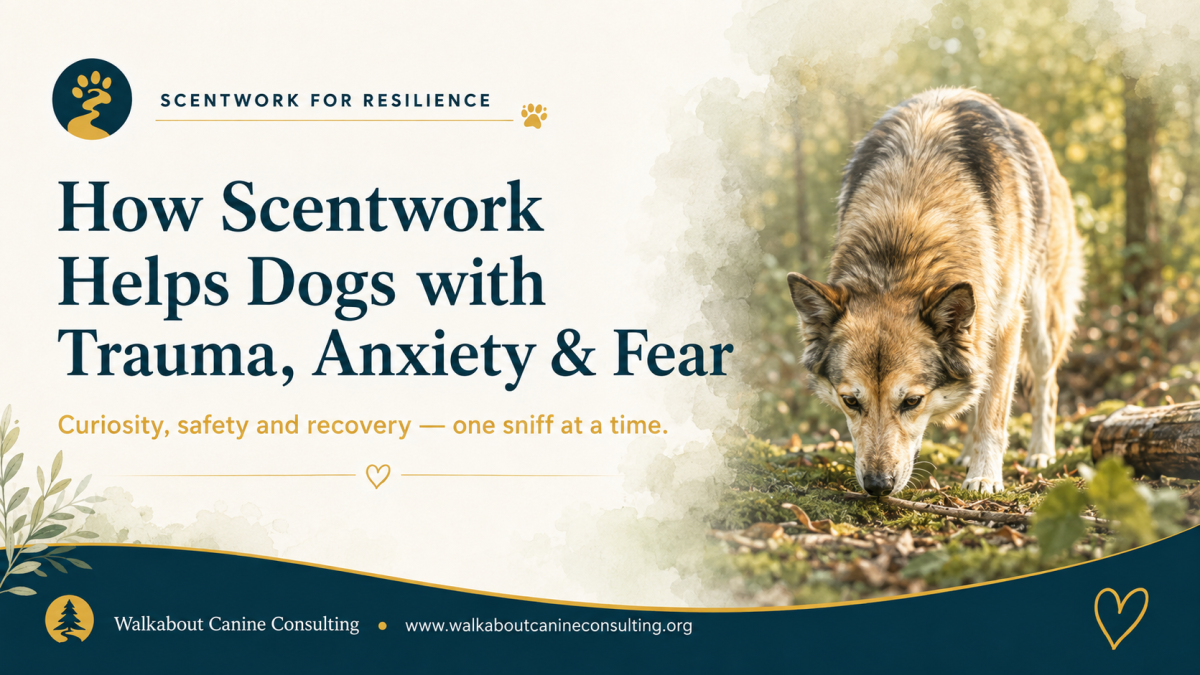
Learn how scentwork can help anxious, fearful and reactive dogs build confidence, curiosity and resilience through sniffing,choice and simple searches
How Scentwork Helps Anxious and Fearful Dogs: Confidence, Calm and Resilience
How nosework and sniffing can support dogs experiencing anxiety, fear, reactivity or the effects of stressful experiences
Scentwork can help anxious and fearful dogs by encouraging natural sniffing, exploration, choice and problem-solving. These activities can support confidence and positive emotional experiences while giving the dog opportunities to investigate the environment at their own pace. Scentwork is not a cure for anxiety, but it can be a valuable part of a broader behaviour plan.
Why Does Sniffing Help Anxious Dogs?
We often think of scentwork as enrichment.
Hide a treat.
Let the dog find it.
Everyone has fun.
But when I'm working with a dog who is anxious, fearful, reactive or struggling after difficult experiences, I look at scentwork somewhat differently.
I'm not simply trying to entertain the dog.
I'm interested in what searching can do for the dog's emotional experience of the world.
Because fear tends to make the world smaller.
Scentwork can gently help the dog begin exploring it again.
Fear Changes What a Dog Notices
Imagine walking into a dark parking garage late at night after you've recently experienced something frightening.
You're probably not admiring the architecture.
You're listening.
Looking.
Checking behind you.
Your brain is asking:
“Where is the danger?”
Dogs do something very similar.
A worried dog may scan constantly.
They may startle at sounds, stare at dogs in the distance, react to movement, avoid unfamiliar objects or become unable to disengage from something they perceive as threatening.
We often label what comes next as a behaviour problem:
“He won't listen.”
“She barks at everything.”
“He's stubborn.”
“She can't focus.”
But the behaviour is the end of the story. I want to know what was happening before it.
What was the dog's emotional system telling them?
Because a brain busy looking for danger has fewer resources available for curiosity, exploration and learning.
And that is where scentwork becomes interesting.
Sniffing Gives the Dog Another Job
Dogs evolved with an extraordinary reliance on olfaction. Their noses aren't an accessory.
Scent is one of the major ways dogs collect and interpret information about their environment. Modern reviews of canine olfaction describe close relationships among smell, memory and emotion.
So when your dog stops for forty-five seconds to investigate one apparently fascinating blade of grass, they aren't wasting the walk.
They are gathering information.
We humans tend to want to get somewhere.
Dogs often want to find out what happened there.
That difference matters.
The Emotional Power of SEEKING
One concept I find particularly useful comes from neuroscience and the SEEKING system, a core primal emotional-motivational network in the mammalian brain, identified by affective neuroscientist Jaak Panksepp.
SEEKING is associated with exploration, motivation, anticipation and curiosity.
In very simple terms:
Fear says:
“Something may be wrong.”
The SEEKING system says:
“Let's find out what's here.”
Scentwork naturally gives the dog something meaningful to investigate.
And instead of us constantly controlling the answer, the dog begins doing the work.
That gives us another important ingredient.
Agency - How Does Scentwork Build Confidence in Fearful Dogs?
Agency means having some influence over what happens to you.
For many fearful dogs, this is enormously important.
Think about how different these two experiences feel: someone pushes you through a door you are worried about.
Versus: the door is open, you can investigate it, leave, come back and decide when you're ready to enter.
Same doorway. A completely different experience.
Good scentwork gives the dog decisions.
Where should I search?
Which box smells interesting?
Should I investigate this corner?
Can I walk away?
Can I come back?
Dogs don't need unlimited choice every second of their lives. But opportunities for safe, successful choice matter to welfare.
And nose work provides this beautifully.
Scent work May Even Help Dogs Become More Optimistic
This is one of my favourite pieces of research around nose work.
In a 2019 study, Duranton and Horowitz compared pet dogs participating in nosework with dogs practising heelwork.
Both groups were doing activities with their guardians.
But after two weeks, the nosework dogs showed a more positive response on a cognitive-bias test.
In plain English?
They were more likely to behave as though an uncertain situation might turn out well.
Researchers described this as increased positive judgement bias — or optimism.
That's fascinating when we think about fearful dogs.
Because anxiety often involves expecting that something uncertain could be dangerous.
Imagine gradually shifting that prediction toward: “Maybe something good is going to happen.”
We're not erasing fear.
We're giving the brain another history to draw from.
Small Wins Matter - How Should I Start Scentwork With an Anxious Dog?
I often tell clients that confidence isn't something we install in a dog.
It is something the dog collects.
One successful experience.
Then another.
Then another.
A dog searches one easy box.
Finds the food.
Success.
Next time there are two boxes.
Success.
Later we move into another room.
Success.
Then perhaps outside.
Success.
Eventually the dog encounters something mildly unfamiliar and instead of immediately withdrawing thinks:
“I might be able to investigate this.”
That's resilience developing.
Not fearlessness.
Resilience. There is an important difference.
There is an important difference. Resilience is the ability to bounce back, adapt, and keep going after bad things happen. It is like a mental muscle or an elastic band that bends under pressure but returns to its original shape.
Regulation Doesn't Mean Permanent Calm
We also need to rethink what we mean by a “regulated dog.”
A regulated dog isn't a dog lying quietly twenty-four hours a day.
Dogs should become excited.
Play.
Run.
Investigate.
Search.
Get interested.
Regulation means the dog can move through different levels of arousal and recover afterwards.
This is one reason I like the pattern:
Search → Success → Recover
The search brings focused activity.
The find gives the dog information and reinforcement.
And then we allow recovery.
That last part is often forgotten.
We don't need to keep adding another search, another exercise, another game and another challenge until the dog is exhausted.
Sometimes the best training decision is:
“That was lovely. We're finished.”
Scentwork Should Not Become Another Form of Pressure
This is particularly important with fearful dogs.
Scentwork isn't automatically therapeutic simply because the dog is sniffing.
Imagine a dog terrified of strangers.
If I place food beside a stranger and encourage the dog to “find it,” the dog may technically be scenting.
But I could also be creating conflict.
The dog wants the food.
The dog wants distance.
That isn't the emotional lesson I want.
The activity needs to remain within what the dog can genuinely cope with. But...as long as the dog has the freedom to move away and observe and process without us pressuring or coaxing we can help the dog gain confidence. This is exploration.
We are using scentwork to support exploration, not to lure a dog through fear.
Watch the Dog in Front of You
When scentwork is working well, I often see a dog become absorbed in the task.
Their nose stays engaged.
Their movement becomes purposeful.
They can investigate, move away and return.
They appear interested rather than frantic.
They can find something and then recover.
But if the dog begins scanning the environment instead of searching, freezing, repeatedly abandoning the task, becoming frantic or refusing food they would normally take, the exercise may be too difficult.
That's not failure.
It's information.
Make it easier.
Reduce the search area.
Increase distance from distractions.
Return to a familiar environment.
Make the hide obvious.
Or simply stop for the day.
Progress isn't about continually making things harder.
It's about finding the level where learning can happen.
Start Ridiculously Easy
People often want to make scentwork complicated far too quickly.
You don't need expensive equipment.
Start with food scattered across the kitchen floor.
Then grass.
Then one cardboard box.
Then several boxes.
Then a simple room search.
Eventually you can use different heights, furniture, outside environments and more complex scentwork.
But first let the dog discover:
Using my nose works.
And then:
I can solve things.
And eventually:
I can cope with something I haven't seen before.
That progression is far more important than how impressive the final search looks.
Are Sniff Walks Good for Anxious Dogs?
Don't Rush the Sniff Walk Either
Scentwork doesn't only happen in boxes.
Allowing a dog to investigate their environment on walks is one of the simplest ways of giving them olfactory choice.
For humans, a walk tends to be measured in distance.
For dogs it can be measured in information.
A dog who spends ten minutes investigating a hedge may be doing far more meaningful work than the dog being marched briskly past it.
Sometimes we need to stop thinking:
“We only walked one kilometre.”
and start thinking:
“Look how much my dog experienced.”
Can Scentwork Help a Dog Who Has Experienced Trauma?
We should be careful with this word.
We cannot look at a behaviour and automatically conclude that a dog has experienced psychological trauma.
Fear, chronic stress, genetics, early development, pain, learning history and environment can produce behaviours that look very similar.
What we can recognise is when a dog is struggling to feel safe, recover from stress or confidently investigate their world.
For those dogs, trauma-informed principles can still be extremely useful:
Safety.
Predictability.
Choice.
Agency.
Small achievable challenges.
Recovery.
And avoiding unnecessary pressure.
Scentwork fits beautifully within those principles when it is used thoughtfully.
Scentwork Isn't the Whole Treatment Plan
If a dog is experiencing significant fear or anxiety, nosework shouldn't become our answer to everything.
It cannot replace appropriate management, veterinary investigation, pain assessment, behaviour modification or medication when medication is warranted.
But it can become a valuable piece of the dog's toolbox.
And sometimes it is the quiet pieces of the toolbox that create remarkable change.
A cardboard box.
A handful of treats.
A patch of grass.
A guardian who stops directing for a moment.
And a dog who begins to investigate.
The Real Goal
When I introduce scentwork to worried dogs, my goal isn't to create competition scent-detection dogs.
I'm looking for something much more useful.
A dog who investigates.
A dog who makes decisions.
A dog who experiences success.
A dog who can become engaged and then recover.
And perhaps, over time, a dog whose first response to something uncertain begins shifting from:
“I need to protect myself from this.”
toward:
“I wonder what that is?”
That is why scentwork matters.
Fear can narrow a dog's world.
Curiosity can begin opening it again.
And sometimes that process starts with something beautifully simple:
letting the dog sniff.
Can scentwork help an anxious dog?
Yes. Scentwork can provide opportunities for sniffing, exploration, problem-solving and choice, which may support confidence and positive emotional experiences. It should be used alongside appropriate management and behaviour support when anxiety is significant.
Does sniffing calm dogs down?
Sniffing can be part of a lower-pressure, exploratory activity and many dogs appear more settled after opportunities to sniff. Rather than assuming sniffing automatically makes every dog calm, watch the individual dog's body language and recovery.
How long should a scentwork session be?
For worried dogs, start with only a few easy searches. Two or three successful minutes can be more useful than a long session that becomes frustrating.
What is the easiest scentwork game for an anxious dog?
Scatter a few treats across a familiar floor or patch of grass and allow the dog to find them without directing or rushing them.
Can scentwork replace behaviour training for anxiety?
No. Scentwork is a supportive tool. Dogs with significant anxiety or fear may also need environmental management, behaviour modification, veterinary assessment and, in some cases, medication.
Sylvia Koczerzuk is a Certified Dog Behaviour Consultant with Walkabout Canine Consulting, supporting dog guardians with anxiety, reactivity, fear, resource guarding and behaviour concerns in Windsor–Essex, Ontario and virtually. Sylvia has also published a book called Resource Guarding in Dogs : Understanding with Compassion
www.walkaboutcanineconsulting.org
Categories: : Arousal & Calmness