Positive Dog Training & Behaviour Blog | Walkabout Canine Consulting
Unleashing your dogs potential, one concept at a time
Why Is My Dog Eating Non-Food Items? Pica and Digestive Health
 Sylvia Koczerzuk

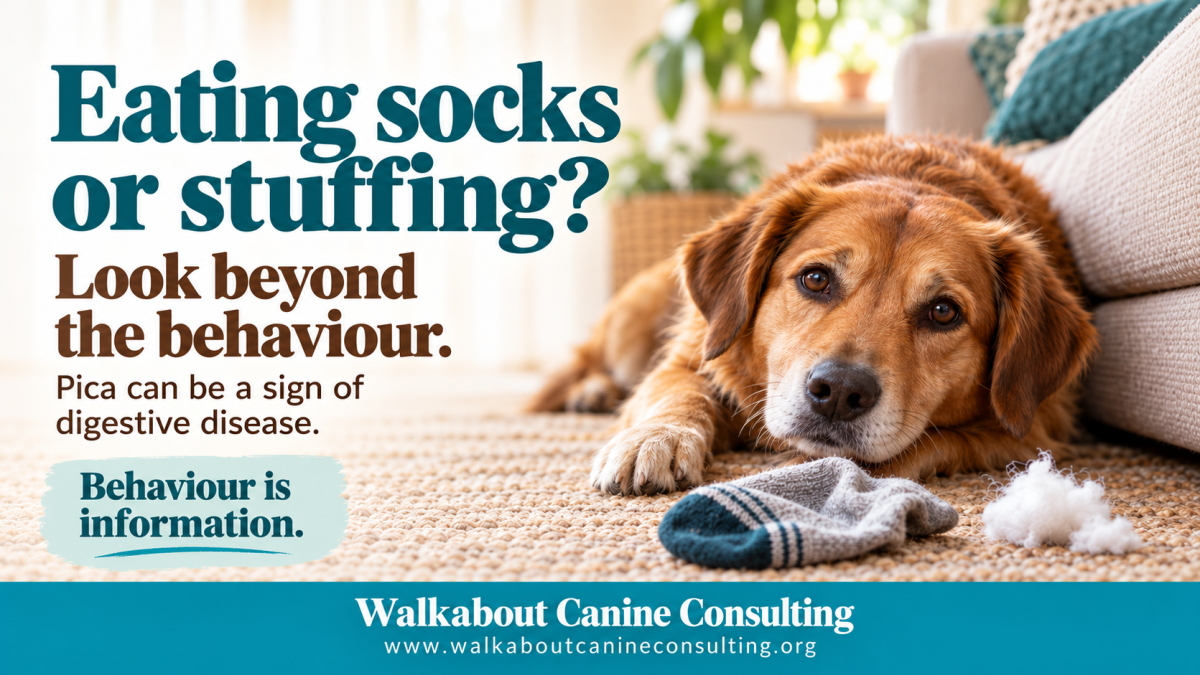
Is your dog eating socks, stuffing, or other non-food items? Learn what pica may reveal about digestive health and when to speak with your veterinarian.
“Why does my dog eat socks?” might sound like a training question, but it can also be a health question. Repeatedly swallowing non-food items is called pica. While behaviour and environment can contribute, research suggests that chronic digestive disease deserves consideration, too.
Eating socks or stuffing? Your dog’s behaviour may be telling us something about their health.
When a dog repeatedly swallows socks, furniture stuffing, fabric, or other non-food items, it can be frightening and frustrating.
But before we label the dog “naughty,” we need to ask: Could something be happening inside their body?
Repeatedly eating non-food items is called pica, and research offers an important reason to investigate digestive health.
A 2025 study by Dr. Julianna Perez and colleagues reviewed dogs and cats undergoing endoscopic removal of foreign objects from their stomachs. Among the 41 animals included in the biopsy analysis, every animal had evidence of chronic intestinal inflammation. All 41 also had a history of ongoing gastrointestinal signs.
That does not mean every dog who eats a sock has intestinal disease. This was a selected group of hospital patients, and the findings do not prove that inflammation caused the behaviour. They do, however, support considering chronic digestive disease when investigating pica.
Behaviour is information. Our job is to get curious about what it might mean.
As a dog behaviour consultant, I want to understand the whole dog: their experiences, environment, emotions, learning history, and physical comfort. Medical investigation and behaviour support can work together.
If your dog repeatedly eats non-food items:
🐾 Speak with your veterinarian. Describe what your dog swallows, how often it happens, and any changes in appetite, vomiting, stools, or daily behaviour. A written record can help you share the full picture.
🐾 Make prevention a priority. Secure laundry, block access to stuffing, and remove damaged toys. Choose activities your dog can enjoy without swallowing the materials.
🐾 Avoid reprimands. Focus on preventing access and teaching useful skills, such as moving away from an item and exchanging it willingly.
🐾 Look beyond the immediate incident. Removing access is essential, but repeated swallowing deserves investigation into what may be contributing.
If you suspect your dog has swallowed an object, contact your veterinarian promptly for guidance.
We can protect our dogs while asking better questions about their behaviour. Sometimes the next step is a veterinary conversation.
Sylvia Koczerzuk, CDBC
Walkabout Canine Consulting
www.walkaboutcanineconsulting.org
Research: Perez, Ford & Lynch (2025), Pica as a clinical sign of a chronic enteropathy in dogs and cats, JAVMA.
Read the study
#DogBehaviour #PicaInDogs #CanineWellbeing #WalkaboutCanineConsulting