Positive Dog Training & Behaviour Blog | Walkabout Canine Consulting
Unleashing your dogs potential, one concept at a time
Can Pain Cause Behaviour Changes in Dogs? When it's more than behaviour.
 Sylvia Koczerzuk
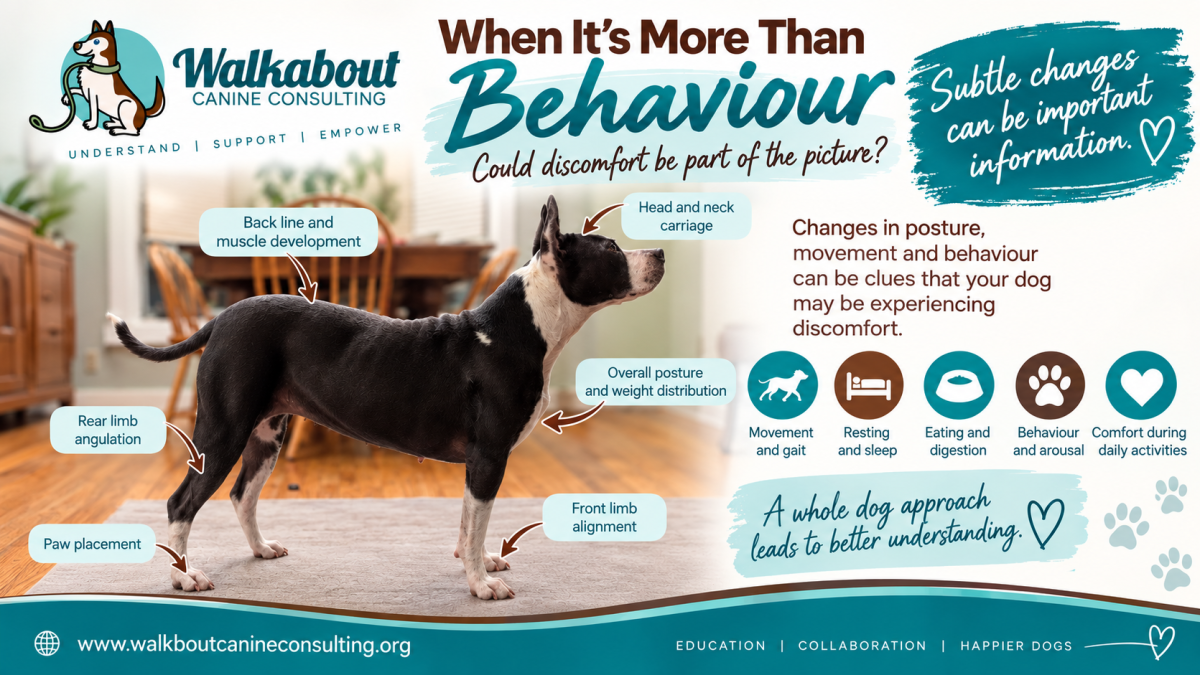
Could pain or discomfort be affecting your dog's behaviour? Learn how changes in sleep, movement, appetite, gut health, arousal and behaviour can prov
When It’s More Than Behaviour: Could Discomfort Be Affecting Your Dog?
As a dog behaviour consultant, a large part of my continuing education is, naturally, about behaviour.
But understanding behaviour also means understanding what behaviour might be telling us.
Sometimes barking is about fear. Resource guarding may be influenced by stress or insecurity. Difficulty settling may be associated with arousal.
But sometimes behaviour gives us clues that we need to look beyond behaviour itself.
Could this dog be uncomfortable?
Could something happening inside the body be influencing what I am seeing on the outside?
I am not a veterinarian. I do not diagnose medical conditions, prescribe medications or recommend which medications a dog should receive.
But as a behaviour consultant, I believe I have a responsibility to recognize patterns that might warrant a conversation with a veterinarian.
Because behaviour doesn't happen separately from the body.
And medical issues aren't always as "silent" as we think.
Pain Doesn't Always Look Like Pain
When people picture a dog in pain, they often imagine an obvious limp, crying, difficulty getting up or a visible injury.
Chronic discomfort can look considerably different.
Veterinary pain guidelines recognize that changes in behaviour, posture, gait, demeanour, mobility, sleep and everyday activities can provide important information about possible pain. AAHA specifically recommends that pain assessment extend beyond the hands-on physical examination to include observation of posture, gait and behaviour.
Research examining pain and problem behaviour has also identified associations between painful conditions and behavioural concerns including aggression and noise sensitivity. Musculoskeletal problems aren't the only consideration; painful gastrointestinal and dermatological conditions have also been identified in behaviour cases.
That means I don't necessarily begin wondering about health because I see a dog limping.
Sometimes I begin wondering because the behavioural story doesn't quite add up.
My Behaviour Assessment Starts With a History
When I take a behaviour history, I want to know considerably more than:
"When does your dog bark?"
or
"What does your dog guard?"
I want to understand the dog.
That means asking about things such as:
- How well does your dog sleep?
- What are their bowel movements like?
- Has their stool changed?
- Do they have excessive gas?
- Does the dog air lick or repeatedly lick surfaces?
- Do they gulp or repeatedly swallow?
- Do you see teeth or jaw chattering?
- Does your dog eat non-food objects?
- What are their eating patterns?
- Have those eating patterns changed?
- Do they frequently lick their paws or other areas of their body?
- Do they have recurring ear, skin or anal-area problems?
- What previous acute or chronic health problems have occurred?
- When was their last veterinary examination and faecal testing?
- Is there a history of gastrointestinal disease or parasites such as Giardia?
- How much exercise does the dog receive?
- What kind?
- When?
- What happens behaviourally and physically afterwards?
No single answer diagnoses anything.
I'm looking for patterns.
Pica Gets My Attention
Pica is the persistent ingestion of things that aren't food—fabric, paper, plastic, rocks and other objects.
If I'm told a dog is constantly stealing socks and actually consuming them, for example, I don't automatically categorize that as attention-seeking, boredom or "naughty" behaviour.
I want to know more.
Many experienced veterinary behaviourists consider pica an important reason to investigate gastrointestinal health. Veterinary guidance likewise recognizes gastrointestinal disorders—including inflammatory bowel disease, intestinal parasites and exocrine pancreatic insufficiency—among the possible medical causes of pica. Other medical and behavioural causes are possible as well.
So pica isn't proof that a dog has a gut disorder.
But neither should we automatically assume it is simply a training problem.
It is information worth investigating.
The same applies when I hear about gulping, excessive licking, appetite changes, significant gas or changes in bowel movements.
Instead of immediately asking, "How do we stop this behaviour?", sometimes our first question needs to be:
"Why might this dog be doing it?"
Eating Patterns Matter Too
Another piece of history I pay attention to is appetite.
People sometimes normalize a dog who doesn't eat particularly well or who regularly won't eat until much later in the day.
That may be that individual's established pattern, but a poor or changing appetite deserves our attention—particularly when it appears alongside other physical or behavioural changes.
AAHA includes appetite and behaviour among the observations relevant to canine pain assessment and notes that inappetence can be a subtle sign of pain.
Again, we aren't diagnosing from one symptom.
We're gathering pieces.
Then I Look at Movement
My education also includes recognizing normal and abnormal posture, gait and movement.
That doesn't make me a veterinarian or rehabilitation professional.
It means I may notice something that makes me say:
"I'd like your veterinary team to take a closer look at this."
I might notice changes in:
- how the dog distributes their weight
- the way they sit or lie down
- symmetry
- stride
- head or body carriage
- willingness to jump or use stairs
- transitions between standing, sitting and lying
- how frequently they reposition while resting
- movement before versus after exercise
These observations matter.
AAHA notes that dogs may alter their posture and movement in an attempt to preserve comfort. Weight shifting, unusual resting positions and changes during functional activities such as climbing stairs can provide useful information.
And here's another important consideration:
What we see at home may not necessarily be what appears during a brief veterinary appointment.
Environment, excitement, fear and arousal can affect how a dog behaves and moves.
That's one reason I love video.
If your dog consistently moves differently after a walk, hesitates on stairs in the evening or repeatedly changes position while sleeping, video it.
AAHA specifically recognizes owner photographs and videos as useful when pain is intermittent or connected with activities that cannot easily be reproduced in the clinic.
Depending on the concern, a veterinarian may also recommend evaluation by a veterinary rehabilitation professional or another appropriate specialist.
What Does This Have to Do With Resource Guarding?
Potentially quite a lot.
That doesn't mean resource guarding = pain.
Resource guarding is a complex behaviour and can occur for many reasons.
But imagine a dog who suddenly begins guarding their bed.
Now imagine that the guarding occurs particularly after a long walk.
That interests me.
Maybe it is behavioural.
Maybe the dog is exhausted.
Maybe something about what happens around the bed has changed.
But I also want to consider another possibility:
Is this dog less comfortable after exercise and therefore less tolerant of another individual approaching their resting space?
Pain and behaviour researchers have described several ways pain can interact with behaviour: it may directly produce a behavioural concern, contribute to another existing concern, exacerbate an established behaviour problem, or create additional behavioural signs.
That's very different from saying, "Pain causes resource guarding."
We're asking a much better question:
Could discomfort be one of the factors changing this dog's capacity to cope?
Arousal Can Complicate the Picture
This is another area I pay close attention to.
We sometimes see a dog who appears to be constantly "on."
Pacing.
Moving.
Looking for something to do.
Demanding activity.
Unable to settle.
The understandable response can be:
"This dog needs more exercise."
So we add another walk.
More fetch.
More daycare.
More running.
More stimulation.
But what if constant movement isn't simply excess energy?
What if the dog's inability to settle is another clue?
A dog experiencing physical or visceral discomfort may have difficulty becoming comfortable. And if the dog is also repeatedly experiencing high-arousal activities without adequate recovery, it can become increasingly difficult to understand what is driving what.
This is where I want to look at the whole picture:
activity + sleep + recovery + environment + behaviour + movement + physical health.
More activity isn't automatically the answer to more arousal.
Sometimes we need to investigate why the dog is having such difficulty coming back down.
What If We've Already Reduced the Stress Bucket?
This is a big one for me.
Suppose we have identified the dog's stressors.
We've reduced unnecessary exposure.
We've provided appropriate opportunities for sniffing, licking and chewing.
We've increased predictability and choice.
We've improved sleep and rest.
We've changed the environment.
We're preventing repeated rehearsal of difficult behaviour.
The guardian is consistently implementing the behaviour plan.
And yet...
the dog is still struggling.
Or perhaps the behaviour is actually deteriorating.
That's information.
It doesn't mean the behaviour plan has "failed."
It means our original hypothesis may be incomplete.
A behaviour plan that should be producing progress—but isn't—can be a reason to widen our investigation.
Could there be a medical contributor that is continually adding to that dog's stress bucket?
Sudden Change Deserves Attention
I'm particularly interested when guardians tell me:
"He's never done this before."
A dog suddenly becomes noise sensitive.
A dog who previously slept well becomes restless at night.
A dog begins guarding resting spaces.
A previously tolerant dog becomes sensitive about touch.
Reactivity suddenly intensifies.
Recovery after an exciting event takes much longer.
A dog begins destroying and ingesting objects.
A dog who once settled easily now constantly paces.
These aren't diagnoses.
They're changes from that dog's normal.
And changes deserve questions.
AAHA emphasizes the importance of guardians recognizing differences between their dog's normal and abnormal behaviour, particularly because chronic pain can present through gradual behavioural changes rather than dramatic signs.
What About an Analgesic Trial?
Sometimes veterinary examination and diagnostic testing identify a source of discomfort.
Sometimes they don't.
Research examining pain and problem behaviour argues that when pain is reasonably suspected, veterinarians may consider evaluating the animal's response to trial analgesia even when a specific physical lesion has not been identified.
This is entirely a veterinary decision.
There are different mechanisms of pain, and different types of pain may require different approaches. The medication, dosage, duration, combination of therapies, necessary testing and monitoring are decisions for the veterinarian.
That is particularly important because lack of response to one approach doesn't necessarily mean discomfort isn't present.
Veterinary pain guidelines increasingly emphasize individualized and multimodal pain management rather than assuming one treatment is appropriate for every patient.
For behaviour cases involving suspected chronic discomfort, a short medication trial may also provide an incomplete picture. Published veterinary behaviour cases and specialist guidance describe analgesic trials lasting several weeks rather than just several days.
The important conversation isn't:
"Can I give my dog a pain medication and see what happens?"
It is:
"These are the changes we're observing. Could discomfort be contributing, and would an analgesic trial or further investigation be appropriate?"
That's a veterinary conversation.
Become a Detective
This may be the most useful thing I can teach guardians.
Don't diagnose.
Observe.
Become curious.
Document.
Video.
Look for patterns.
If your dog guards their bed, when does it happen?
After exercise?
At night?
After eating?
Only when lying in a particular position?
If your dog paces, when does it begin?
Before meals?
After meals?
Following exercise?
During the night?
If your dog suddenly becomes noise sensitive, what else changed around the same time?
What does sleep look like?
What does movement look like?
What do bowel movements look like?
What does appetite look like?
The more clearly we can tell the story, the more useful information we can provide to the veterinary team.
It Takes a Village
One of my own doctors once told me:
"It takes a village."
I think exactly the same thing about our dogs.
As a behaviour consultant, I don't need to diagnose arthritis, gastrointestinal disease, neuropathic pain or any other medical condition.
That's not my job.
But I do need enough education to recognize when the behaviour story suggests that we should be asking more questions.
My role may be to help you identify patterns.
Your role may be to document what happens at home.
Your veterinarian's role is to investigate and diagnose medical disease and determine appropriate medical treatment.
Sometimes rehabilitation professionals, veterinary behaviourists or other specialists become part of that team too.
We're each looking through a slightly different window.
Together, we get a much better view of the dog.
So when behaviour changes suddenly, continues to deteriorate, or isn't responding as expected to an appropriately designed and consistently implemented behaviour plan, don't automatically assume that the dog needs more training.
Ask another question:
Could there be more going on here than behaviour alone?
Because behaviour is information.
And sometimes the information our dogs are giving us is telling us that we need to look more closely at the body.
Frequently Asked Questions
Can pain cause behaviour changes in dogs?
Pain and discomfort can influence behaviour, including mobility, sleep, tolerance of handling and social interactions. Research has also identified associations between painful conditions and concerns such as aggression and noise sensitivity. Behaviour change doesn't prove pain, but it can provide a reason for further veterinary investigation.
Can a dog be in pain without limping?
Yes. Chronic pain can present through subtle changes in behaviour, posture, gait, demeanour and everyday activities. AAHA recommends considering all of these when assessing pain.
Can gastrointestinal problems affect a dog's behaviour?
They can. Pain-and-behaviour literature recognizes painful gastrointestinal conditions among medical issues that may be relevant to problem behaviour. GI disease is also one of several medical possibilities veterinarians consider in dogs displaying pica.
Is pica always caused by a gut problem?
No. Pica deserves investigation, and gastrointestinal disorders are important potential causes, but other medical and behavioural explanations exist. A veterinarian should investigate persistent ingestion of non-food objects—particularly because the behaviour itself can also create serious medical risks.
Why does my behaviour consultant ask about sleep, stool and eating?
Because behaviour occurs within a living body. Changes in sleep, appetite, gastrointestinal function, movement and behaviour can help reveal patterns that warrant veterinary investigation. They aren't being used to diagnose your dog; they help us decide whether another member of the dog's care team should be involved.
Should I record videos for my veterinarian?
Yes, when it is safe to do so. Videos of natural movement, resting, stairs or behaviours that are difficult to reproduce in a clinic can provide useful additional information. Never deliberately provoke pain, aggression or distress to obtain a recording.
Is your dog's behaviour changing or not progressing despite a thoughtful behaviour plan? A comprehensive behaviour assessment can help us look at the whole picture, identify patterns and determine what questions may need to be taken back to your veterinary team. I can help you with that. Reach via our website: CLICK HERE or email me at info@walkaboutcanineconsulting.org or text me at 226-348-3948
https://www.aaha.org/resources...Resources AAHA
https://pmc.ncbi.nlm.nih.gov/a...https://pmc.ncbi.nlm.nih.gov/articles/PMC7071134/?utm_source=chatgpt.com