Positive Dog Training & Behaviour Blog | Walkabout Canine Consulting
Unleashing your dogs potential, one concept at a time
Dog Behaviour Management: 6 Ways to Set Your Dog Up for Success
 Sylvia Koczerzuk
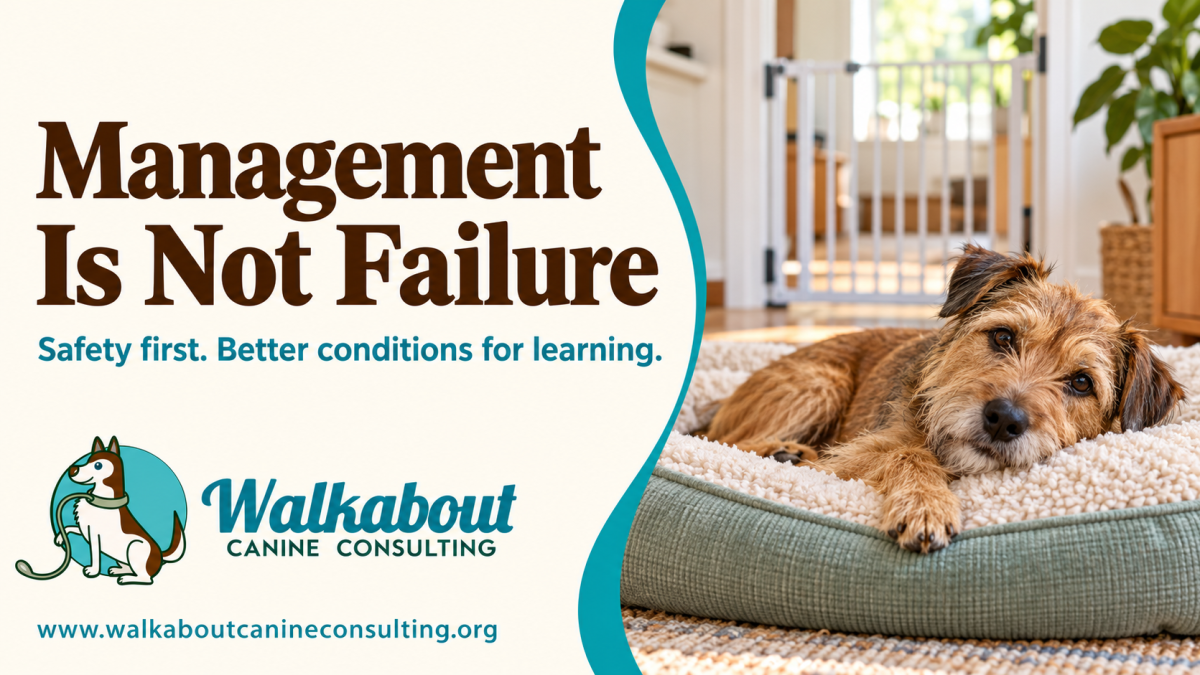
Management is an essential part of helping dogs succeed. Explore six practical types of dog behaviour management, from baby gates and quieter walks to
Dog Behaviour Management: 6 Ways to Set Your Dog Up for Success
By Sylvia Koczerzuk, CDBC | Walkabout Canine Consulting
Dog behaviour management means adapting your dog's environment, routines and interactions to protect welfare, reduce difficult situations and support learning. From baby gates to quieter walking times, thoughtful management creates opportunities for success while you help your dog develop new skills.
Introduction
What if the secret to solving your dog's most frustrating behaviour problems wasn't teachint them a new command, but simply rearranging your living room?
In canine behaviour modification, "management" is often treated as a temporary badage. In reality , it is a powerful form of training that changes how dogs feel, think, and choose. By mastering management, you can stop unwanted habits in their tracks before they even start.
This is what I hope you will take away from their article:
Discover how to limit the rehearsal of unwanted emotional states and behaviors.
Understand why welfare and safety must always be your absolute first priorities.
Identify the six core types of management and how to apply them to real-world cases.
Learn how to set up the environment to make learning easier and more effective for any dog.
The Golden Rule: Welfare and Safety First
Before you get excited about training new skills, you must ensure that everyone is safe and that the dog's welfare is protected. This is the absolute priority of any behaviour plan.
Safety management is not just about protecting humans and other animals. It also involves protecting the dog from injury during distress. For example, a dog suffering from severe separation anxiety might attempt to jump through a window. In this case, preventing access to dangerous escape routes and avoiding absences that trigger panic are immediate welfare priorities. Confinement must be chosen carefully: a crate or closed room can increase distress and injury risk for some dogs. Veterinary and qualified behaviour support are important when a dog is at risk of harming themselves.
Always ask yourself at the start of a case: Is anyone's safety or welfare currently being compromised? If the answer is yes, put appropriate management in place immediately before starting active training.
The Six Types of Management
To make management easy to apply, we can organise it into six practical categories. Think of this as a checklist for any behaviour case:
1. Containment
Physical tools that limit where a dog can go and how they can move, such as baby gates, crates, leashes or long lines. Setting up a “gated community” within the home using multiple baby gates gives you flexibility to separate family members and pets when needed. Choose tools suited to the individual dog, introduce them positively and watch for signs of distress.
2. Environmental Management
Changing the physical environment to alter the choices available. This includes tidying up tempting items, applying frosted window film to block a barking dog's visual access to the street, or moving furniture so dogs cannot stand on a sofa to watch and bark at passersby.
3. Exposure Management
Modifying how, when and how closely a dog encounters a trigger. You can adjust distance, duration and frequency to keep the experience manageable for the dog.
4. Incompatible Behaviour Engagement
Giving the dog an active job that is incompatible with the behaviour you are trying to prevent. For instance, asking for a few familiar, alternating hand touches in a veterinary waiting room can help a comfortable dog engage with you instead of continually scanning the lobby for triggers.
The activity should be easy and enjoyable. If your dog is worried, creating distance or waiting in a quieter area takes priority over asking for more behaviours.
As the saying goes: If you don't give your dog a job, they will become self-employed!
5. Social Management
Managing how other people, children, visitors or animals interact with the dog. This often includes giving humans specific “jobs”, or things to avoid doing, to protect the dog's comfort and preserve progress.
In multi-dog households, management also means making room for each dog's individual needs. A new puppy needs safe opportunities to explore and rest, while resident dogs need breaks from puppy enthusiasm.
Separate feeding areas and comfortable spaces behind suitable gates or closed doors allow each dog to enjoy meals, chews and enrichment without another dog approaching or taking over. Keep dogs separated until everyone has finished and any remaining food or chews have been collected.
Dogs can enjoy living together and still need time and space of their own.
6. Temporal Management
Adjusting when things happen. Walking a dog at a quieter time of day can reduce stressful encounters and provide more opportunities for relaxed sniffing, exploration and practicing skills.
Creating the Right Conditions for Learning
Have you ever tried to learn a complex new skill, like public speaking or calculus, while someone was shouting or waving lights in your face? You probably wouldn't make much progress. Dogs face the same challenge when we try to train them in highly distracting or triggering environments.
Management helps create the conditions for effective learning. By adapting the environment to match the dog's current skill level, such as starting a training session in a quiet room rather than a busy park, we make it easier for them to focus and succeed. Frequent reinforcement in thoughtfully arranged sessions reduces unnecessary errors and helps build confidence step by step.
Management isn't just firefighting; it is a foundation of successful education.
Key Takeaways
- Management limits rehearsal: It reduces opportunities to practise unwanted behaviours and limits exposure to situations that provoke distress, while making helpful choices easier. It does not switch off emotions.
- Welfare and safety come first: Immediate risks must be addressed before beginning active training or behaviour change work.
- The six types provide a checklist: Containment, environmental, exposure, incompatible behaviour, social and temporal management help us customise a comprehensive plan for each dog.
- Management supports training: It helps create the physical and emotional conditions in which a dog can learn. Some strategies also involve practising and reinforcing useful skills.
Frequently Asked Questions
What is management in dog training?
Management means arranging a dog's surroundings, routines and interactions to reduce risk and make suitable choices easier. Examples include using baby gates, putting tempting items away and choosing quieter walking routes. It supports welfare while you work on the skills and emotions involved in behaviour change.
Is management the same as training?
Management and training work together, but they serve different purposes. Management changes the situation; training helps the dog learn. Frosted window film reduces access to passing triggers, while training might help your dog learn to move away from the window. Some strategies combine both.
Does using management mean I have failed my dog?
No. Using a gate, creating distance or choosing a quieter walking time is a practical way to support your dog. You are matching the situation to their current needs and abilities, giving them a better opportunity to feel comfortable and learn.
Can management alone resolve a dog's behaviour problem?
Management may be enough for some everyday situations, such as keeping laundry out of reach. Fear, anxiety, aggression or persistent distress usually need a broader plan that considers emotions, learning, health and the dog's environment. Preventing a behaviour does not necessarily resolve its underlying cause.
How long should I use management with my dog?
Use management for as long as it protects welfare and makes life work better. Some measures can be adjusted as your dog's skills and comfort improve; others remain sensible lifelong habits. Base changes on your dog's response and the level of risk, rather than a fixed deadline.
Need Help Choosing Where to Start?
You do not need to change everything at once. Start with the situation that most needs to become safer or easier, then build from there.
If you would like a clear, compassionate plan for your dog, book a free 15-minute Zoom discovery call with Sylvia.
About the author: Sylvia Koczerzuk is a Certified Dog Behaviour Consultant (CDBC) and the owner of Walkabout Canine Consulting in Kingsville, Ontario. She helps dog guardians understand behaviour, support emotional wellbeing and build practical life skills through humane, reward-based methods.