Positive Dog Training & Behaviour Blog | Walkabout Canine Consulting
Unleashing your dogs potential, one concept at a time
Behaviour Changes Matter: Why Resource Guarding and Multi-Dog Tension Deserve a Closer Look
 Sylvia Koczerzuk
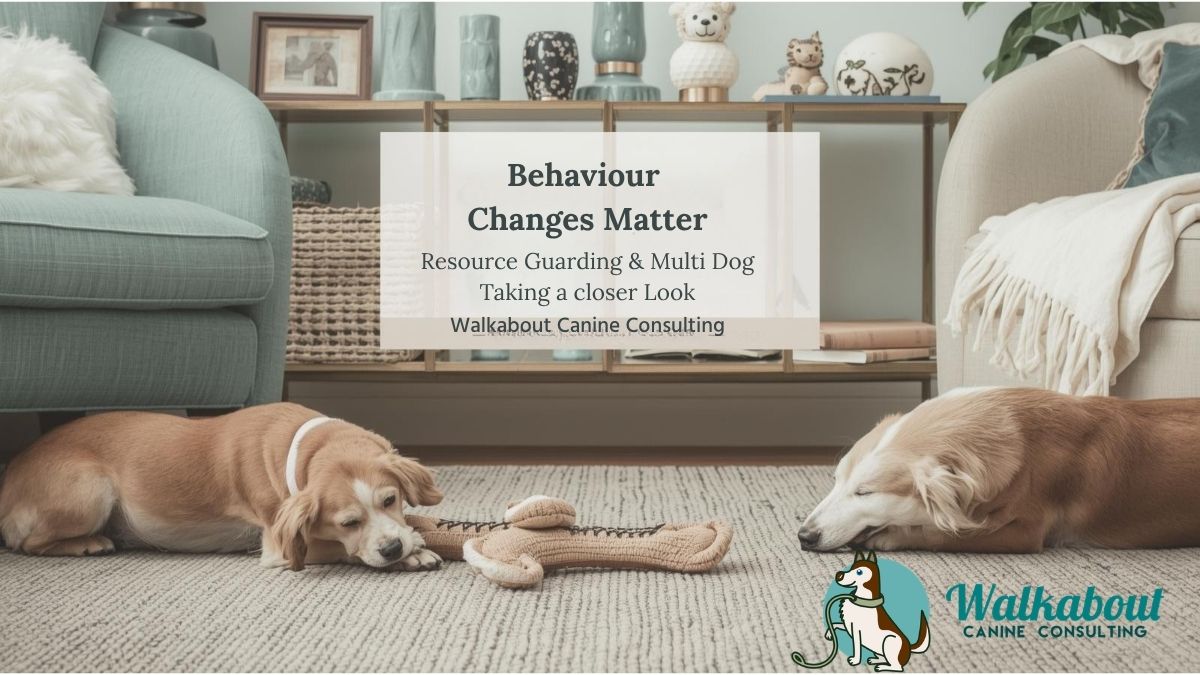
Behaviour changes in dogs matter. This article explains why resource guarding and multi-dog conflict can happen, what may be contributing, and how to
When behaviour changes show up in our dogs, it is easy to focus on what is happening on the surface.
A dog starts growling over a chew.
One dog begins snapping at another near the couch.
Tension builds in the kitchen at feeding time.
Two dogs who used to coexist more smoothly now seem bothered by each other.
It is understandable that guardians feel worried, overwhelmed, or even discouraged when this happens. Behaviour changes inside the home can feel personal, stressful, and confusing. But this is where one important reminder matters most:
Behaviour changes matter — and how you handle those changes is just as important.
That is especially true with resource guarding and multi-dog issues.
Behaviour is information
Resource guarding and conflict between dogs are not simply “bad habits” or signs of a dog being difficult. They are forms of communication. They tell us something in the picture is no longer feeling easy, safe, predictable, or comfortable for that dog.
Sometimes the cause is obvious. A new dog has joined the household. A favourite resting place has become more valuable. Competition around food, toys, people, or space has increased.
Sometimes the cause is less obvious. Pain, illness, hormonal changes, age-related discomfort, stress, changes in routine, or growing emotional sensitivity can all influence how a dog responds in daily life.
In other words, what we see on the outside is often only one part of the story.
Resource guarding is not just about “dominance”
Resource guarding is often misunderstood. Guardians may be told their dog is trying to be bossy, controlling, or stubborn. In reality, guarding is more often about a dog trying to hold onto something they value because they feel uncertain about losing it.
That “resource” might be food, toys, bones, resting places, stolen objects, access to a person, a doorway, or even space itself.
A dog who guards is not necessarily trying to challenge anyone. Often, they are trying to protect access to something important in a moment where they do not feel secure.
That is why how we respond matters so much. Harsh corrections, intimidation, forced removal, or repeatedly putting dogs in situations they cannot handle can add even more pressure to an already loaded picture.
Multi-dog tension can build quietly
In multi-dog homes, behaviour changes can creep in gradually. At first, it might look small.
One dog stiffens near the water bowl.
Another starts hovering around the other dog’s chew.
A dog who used to walk by easily now pauses and stares.
Play becomes more intense, less balanced, or harder to interrupt.
These moments matter.
Dogs living together are constantly responding to each other’s movement, energy, history, and social patterns. One dog may be stressed. Another may be sore. One may be maturing into adolescence. Another may be less tolerant as they age. One may begin to feel crowded. Another may learn that rushing in works.
This is how conflict can begin to build.
Not every issue becomes a fight, but every repeated moment teaches something. When we ignore the early signs, the behaviour often becomes louder because the need behind it has not been addressed.
Medical factors must be considered
One of the most important things guardians can do when behaviour changes appear is to consider the possible role of physical health.
Pain can change everything.
A dog with discomfort may become more sensitive around handling, space, movement, other dogs, or resources. Even subtle changes in mobility, posture, sleep, appetite, digestion, heat cycles, or recovery can influence behaviour.
That is why sudden or gradual changes deserve attention.
Taking notes helps. Notice what changed, when it happens, what was present, and whether anything else shifted around the same time. These observations can be incredibly useful when speaking with your veterinarian.
A behaviour consultant can also help you organize what you are seeing so that the picture becomes clearer. That can make veterinary conversations more productive and help everyone move forward with better information.
Reassurance for guardians
If this is happening in your home, it does not mean you have failed your dog.
It means something needs attention.
Dogs do not create behaviour in a vacuum. Behaviour is influenced by emotion, environment, learning history, stress, health, and the details of daily life. The goal is not to feel ashamed. The goal is to get curious, stay safe, and respond thoughtfully.
That is where real progress begins.
What to do next
If you are seeing resource guarding or tension between dogs in the home, start here:
Observe before reacting.
Take notes on patterns, triggers, locations, body language, and changes over time.
Avoid forcing dogs to “work it out.”
Reduce pressure around valued items, people, and spaces.
Speak with your veterinarian about any changes in behaviour.
Reach out to a qualified behaviour professional who can help you assess the situation clearly.
Support does not just help with training. It helps with understanding. And understanding gives you a far better starting point than guessing, blaming, or hoping it will pass.
Final thought
Behaviour changes matter — and how you handle those changes matters too.
With resource guarding and multi-dog issues, the goal is not to react harder. It is to look deeper.
When we slow down, notice patterns, consider health, and respond with clarity, we give ourselves a much better chance of helping dogs feel safer and making life at home more peaceful for everyone.
If your dog is showing signs of resource guarding or tension with another dog in the home, do not wait for things to escalate. Start taking notes, speak with your veterinarian, and get support from a qualified behaviour consultant who can help you create clarity and a practical plan. You do not need to figure it all out alone.
Categories: : behaviour issues, dog resource guarding reason, multi dog