Positive Dog Training & Behaviour Blog | Walkabout Canine Consulting
Unleashing your dogs potential, one concept at a time
My Person is Home! - Dogs who are over excited
 Sylvia Koczerzuk
“My person is home!”
The behaviour list tells us the arousal has tipped over into loss of thinking skills:
- Jumping = “I need access to you now.”
- Barking = emotional overflow.
- Zooming = movement releasing pressure.
- Ripping clothes = mouthy displacement/frustration, often when excitement has nowhere appropriate to go.
Did you know?
When your dog repeatedly practises high-arousal greetings — jumping, barking, zooming, grabbing clothing, or becoming frantic when you come home — that pattern can begin to spill into other parts of the day. Arousal does not always stay neatly in one box. When the nervous system practises going from 0 to 100, your dog may have a harder time thinking clearly in other situations too, such as visitors arriving, fence-line barking, multi-dog tension, or even resource guarding.
This does not mean the greeting behaviour “causes” all those issues, but it can contribute to a dog who is living closer to the top of their stress bucket. By creating a calmer arrival routine, we help the dog rehearse regulation, predictability, and better choices — skills that can support the whole household, not just the moment you walk through the door.
Understanding My Dogs Behaviours
What we are actually trying to teach
We are not trying to stop the dog from being happy.
We are teaching:
“When my person comes home, I have a predictable routine that helps my body calm down.”
Think of it like a kettle boiling. We do not yell at the kettle for steaming. We turn the heat down.
First priority: change the arrival picture
Coming through the door has become the biggest predictor of excitement. So we need to make arrivals boring, calm, and structured.
Arrival routine
Before coming inside, you want to think of the plan:
- Come in calmly
- Avoid excited talking
- Avoid direct eye contact at first
- Avoid hands reaching down
- Toss food away from the body
- Give the dog something to do
- Greet only when the dog can think again
This is not ignoring the dog forever. It is helping the dog calm down enough to be successful.
Use food to create movement away from the owner
As soon as you enter, you can calmly toss several treats onto the floor, away from the dog's body.
This does a few things:
- Moves the dog’s feet away from the human
- Puts the dog’s nose down
- Switches the brain into sniffing/searching
- Reduces jumping
- Gives the dog a job other than grabbing clothing
A simple cue could be:
“Find it.”
Then scatter several treats on the floor.
The dog cannot jump, rip clothing, and search for food at the same time. Lovely little behaviour math.
Prepare an arrival station
Have something ready before the owner comes home:
- A stuffed Toppl
- A lick mat
- A Kong
- A snuffle mat
- A scatter feed area
- A chew in a safe zone
The moment the owner enters, the dog is directed to the prepared activity.
This changes the picture from:
“Owner comes home = explosion!”
to:
“Owner comes home = I go sniff, lick, chew, and settle.”
Management matters
If the dog is already rehearsing ripping clothes, we need to prevent practice while teaching the new pattern.
Helpful options:
- Baby gate
- Ex-pen
- Leash attached before arrival, if another person is home - see below for this easy option.
- Dog behind a barrier with a prepared enrichment item
- Owner enters through a different door temporarily
- Remove access to loose clothing, scarves, sleeves, dangling bags
This is not punishment. This is setting the dog up so they do not keep rehearsing the Olympic sport of “Welcome Home Chaos.” Gold medal energy, poor life skill.
Teach the skill when you are not arriving
This is important.
Do not only practise when your dog is already at a 10/10.
Practise “fake arrivals” when your dog is calmer:
- Step outside for 5 seconds.
- Comes back in quietly.
- Tosses “find it.”
- Dog sniffs.
- You stays calm.
- Repeat.
Then build slowly:
- 10 seconds outside
- 30 seconds
- 1 minute
- Coming in with keys
- Coming in with coat
- Coming in with bags
- Coming in after a real absence
We are layering the picture.
What not to do
I would avoid:
- Pushing the dog down
- Yelling “off”
- Grabbing the collar
- Excited greetings
- Rough play right away
- Waiting until the dog is frantic and then trying to train
Those may accidentally add more arousal or create frustration.
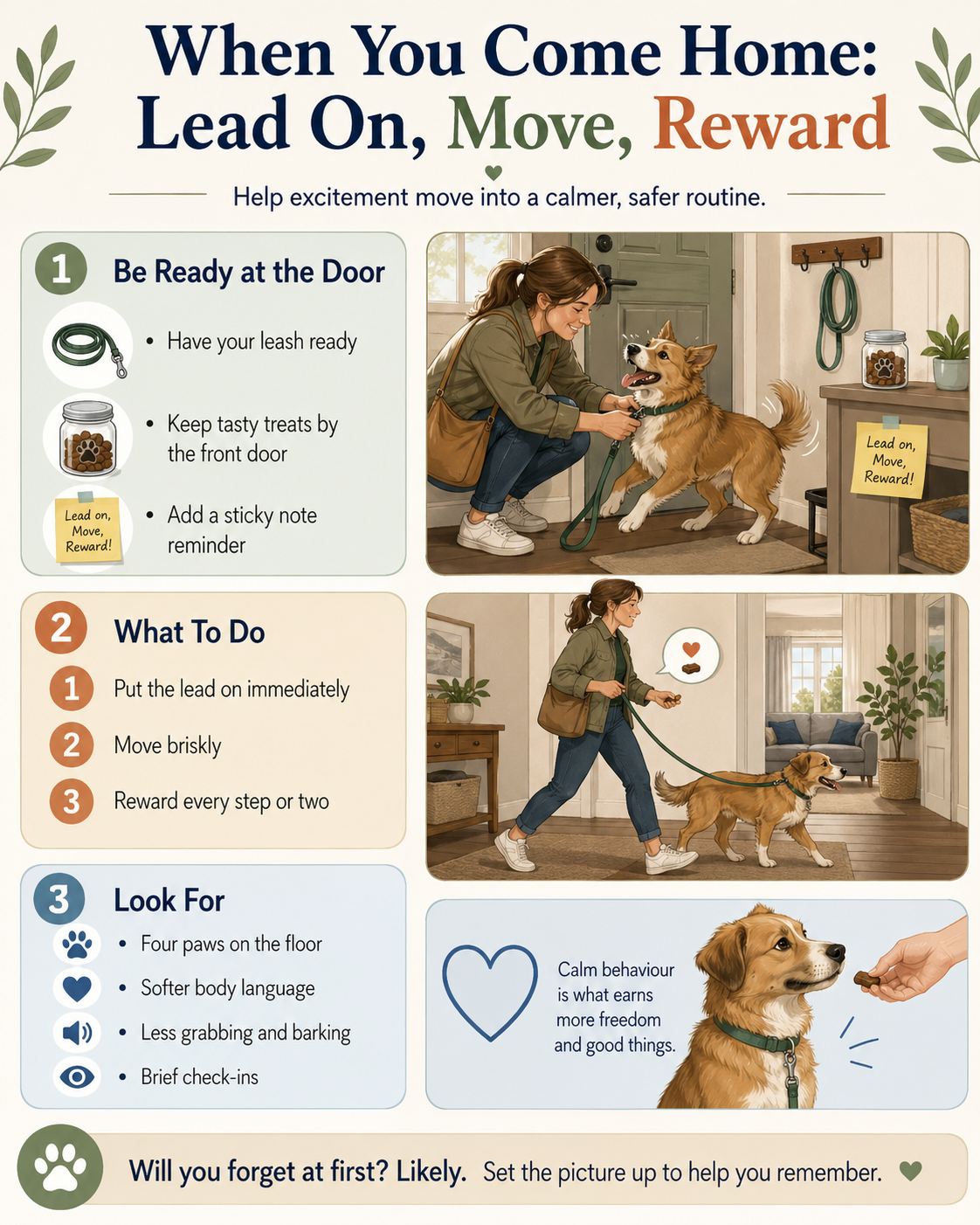
Target Behaviour: Lead On, Move, Reward
When you arrive home, the goal is to quickly and calmly help your dog move their body in a more organized way.
Instead of trying to stop the excitement, we redirect it into a predictable movement pattern.
Set Up Before You Need It
Have everything ready at the front door:
- Leash attached or hanging within easy reach
- Jar of tasty treats by the door
- A clear walking path, such as hallway, kitchen loop, or front entry area
- A reminder note on the closet door or front door
And yes — will you forget at first? Probably.
That is normal. New routines need their own training plan too. A sticky note is not fancy, but it is often the unsung hero of behaviour change.
What To Do When You Come Home
Come in calmly.
Keep your voice low and your movements purposeful.
Put the lead on immediately.
This gives you gentle guidance and prevents your dog from launching into the full zoom-jump-grab routine.
Start moving briskly.
Walk with purpose. Do not stand still and try to negotiate with an excited dog. Standing still often makes the arousal worse.
Reward every step or two.
Feed frequently at first. You are helping your dog’s brain and body shift into rhythm.
Mark and reward calmer moments.
Look for tiny signs of change:
Four feet on the floor
Softer body
Less grabbing
Brief check-in
Slower movement
Ability to take food gently
A tiny pause or breath
Keep it short.
This does not need to be a long session. Even 30–60 seconds of structured movement can help interrupt the chaos loop.
Why This Works
Excited dogs often need help organizing their bodies before they can organize their brains.
Movement gives the excitement somewhere safe to go. The lead adds gentle structure. Frequent reinforcement tells the dog:
“This is the pattern that works when my person comes home.”
Over time, the arrival picture changes from:
“Owner home = explode, jump, bark, grab clothing!”
to:
“Owner home = lead on, move together, get rewarded, calm down.”
Important Reminder
This is not about yanking, correcting, or forcing the dog. The lead is simply there to help guide movement and prevent rehearsal of behaviours that are hard to interrupt once they are in full flight.
Think of it like putting bumpers on a bowling lane. We are not blaming the ball for rolling wildly — we are creating the path to success.
If you need help with figuring out your dogs behaviours or want to continue learning about dog training my membership is the perfect place to continue on your journey. See below.
Who has checked out our Membership Bundle? Get $20.00 off with this COUPON. Get membership here.
If you want to chat lets book a discovery call HERE